5 common misconceptions that all of us have about AI-driven development
The Internet is obsessed with AI nowadays. Every social media is filled with promises of technical revolution that AI is bringing to the moment, with all things that it can improve or even do instantly and effortlessly. In many cases, this is true – we are currently living in times of huge change, and partially […]
Technologies
The Internet is obsessed with AI nowadays. Every social media is filled with promises of technical revolution that AI is bringing to the moment, with all things that it can improve or even do instantly and effortlessly. In many cases, this is true – we are currently living in times of huge change, and partially this is because of AI.
However, there are a lot of common misconceptions that clients and even developers have about AI-driven development. In this blog, I gather 5 examples from real cases that I experienced myself or heard from trusted colleagues.
Misconception 1: using AI will make estimates at least 2x smaller
This is the most common thing that clients think will happen if teams use AI in development. This is understandable because time is money, and developing fast means getting ahead of everyone else. However, this is not how things are working with AI.
And well, it is true that AI will decrease the amount of time needed for coding itself, other phases of software development such as planning, writing detailed technical specifications, communicating with clients or team mates about solutions etc.
From current experience, I can see a huge shift in estimates to spend more time in planning and getting all things ready for AI, then planning features using AI and a much smaller estimate for coding itself. If we are talking about full estimates, the overall cut is not that drastic as it is sold in socials by AI companies.
Also, AI integration usually happens in the course of a couple sprints. So even when cut in estimates happened in numbers, for clients, usually it doesn’t feel that much, because it happened gradually and good things become normal really fast, just basic human psychology.
Misconception 2: AI-driven development needs less skilled developers
Another thing that is used as a selling point in AI driven development is that you can have less skilled and smaller teams to cover the same amount of tasks with AI.
It is partially true that a small and skilled team can cover a lot more tasks with AI, but there are nuances.
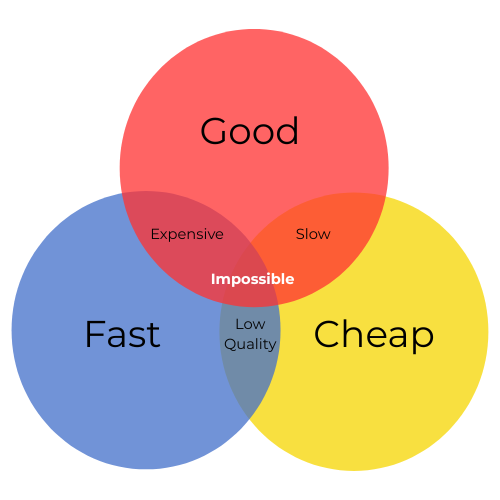
Socials nowadays are full of stories where businesses got rid of their skilled teams and hired unskilled developers who use AI or replaced half of the team with AI, and it didn’t work. Reality is that even with features developed by AI, the codebase still needs a human to control and rule development. So I guess we never move out of classical Good, Cheap, Fast – and everyone gets only two.
Misconception 3: with AI you don’t need strict processes, rules, tests and architecture on a project
Unfortunately, using AI will not replace architecture, processes and well built pipelines. In fact, it is inherently hard to do AI-driven development without all of those things.
With a project that has a huge, unstructured codebase without documentation, AI will take a long time to figure out how to implement features, resolve bugs and do a code review. Also, it will cost more because a lot of tokens will be spent to slice into a 2000+ lines of code files and get what is needed to move further.
Think about AI as a train – when you have rails, an even and well-managed train will move fast and smoothly. Even when rail maintenance is expensive, it is still worth it.
Misconception 4: AI will follow your work process no matter what

I want to explain this to you with this example: a lot of people have a robot vacuum cleaner at home. When you first buy a robot vacuum you think that this will resolve all issues with cleaning your floor forever and you will never need to think about it ever again. So you take it home, find a place for it to live, do basic setup and clean for the first time – works fantastic and exciting.
But time passes and you understand that robot vacuums need to be cleaned time after time. You can’t have cables, small toys or socks all over the floor because robots will get stuck on them, and some places are not reachable for robots so dust covers these places.
There are two ways to move further to resolve this – change your home for a robot to work efficiently or get rid of it.
So you remove all hanging cables, stop throwing socks on ground and periodically clean places out of reach and clean the robot itself.
This is the exact thing that you will have while implementing AI into your development process. AI will bend to your needs to some extent, but to use it efficiently and without huge token expenses you need to change your ways quite a lot.
Misconception 5: AI can develop anything that you want and never say no
AI can build a lot of things that took days or weeks of development before, can resolve a lot of things, and make a lot of things easier – but it can’t defy laws of physics. If some feature can’t be implemented, AI will try to find a hack or other way around this but almost never tell you the truth. It is because it was built so you feel satisfied with it and use it more.
For now, AI needs a skilled engineer for reality checks and guidance.
In conclusion
I must say that AI is a great, powerful instrument that allows all of us to achieve results quicker, better, and more. It is one of the instruments under the belt of skilled engineers, developers, and managers, and it will help you if you use it with a clear mind and understanding that it is not a silver bullet.
At Swan Software Solutions, we use AI in the best way possible to help us succeed in making our clients meet their technology goals. To find out more about how our team could help your team with its technology needs, schedule a free assessment.